
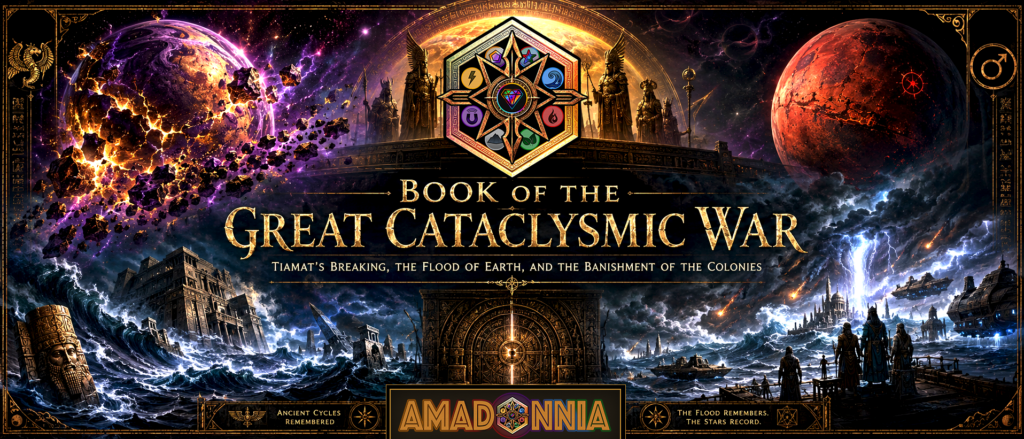
The Book of Tiamat’s Breaking, the Flood of Earth, and the Banishment of the Colonies
Chapter 1: Rumblings of Revolution
- And it came to pass twelve thousand years before the present age of men, when the colonies of Earth had grown powerful and the human populations had multiplied across the face of the planet, that the old resentments erupted into war.
- The Valhallans, displeased with their northern allotment, began to stir rebellion. They looked upon the wealth of the other colonies and said,
- “Why should the late-comer be made lesser? Why should the cold lands be ours while the older empires feast upon the golden regions of Earth? Are we not warriors? Are we not heirs of the storm? Shall we bow forever before the decree of the Anunnaki?”
- And they whispered among the Igigi. For the Igigi had never forgotten the humiliation of the mines.
- Though they had become overseers, they were still beneath the Anunnaki. Though they commanded humans, they were still commanded by higher blood.
- Therefore many Igigi listened. And the Valhallans whispered also among Olympia and Di Consentes. For the Olympians coveted influence, beauty, tribute, and worship. And the Di Consentes desired law and order beneath their own imperial hand.
- Thus a hidden alliance began to form. The Valhallans stirred the humans with tales of injustice.
- They gave weapons to certain tribes. They promised freedom to the Igigi. They offered power to ambitious human kings. They spoke of a new order in which Earth would no longer serve as a labor world beneath Anunnaki supremacy.
- And the humans, violent and brilliant, listened. For humanity had grown beyond its first purpose.
- The creature made for labor had become a creature of language, memory, desire, strategy, hatred, worship, and war.
- Men had learned to build. Men had learned to rule. Men had learned to kill not merely for hunger, but for symbols, gods, crowns, revenge, and control.
- The Anunnaki saw this and were troubled. But they saw it too late.
Chapter 2: The Initiation of the War
- The war began in hidden places. Mines were sabotaged. Gate-temples were defiled.
- Igigi overseers turned against Anunnaki masters. Human armies rose beneath banners they barely understood.
- Atlantean sea engines were attacked. Orisha thunder sanctuaries were raided. Olympian citadels changed allegiance. Dii Consentes strongholds armed rebel provinces.
- Valhallan sky-forges awakened weapons forbidden by treaty. And Earth shook beneath the multiplying conflict.
- At first the Anunnaki believed the rebellion could be contained. They sent commanders. They issued decrees. They demanded surrender.
- But the rebellion spread faster than expected. For the humans were many. The Igigi knew the labor systems. The Valhallans knew war. The Olympians knew seduction, intrigue, and betrayal. The Dii Consentes knew organization, roads, supply, and imperial command.
- Thus the conflict became not a revolt only, but a planetary war.
- And the war did not remain upon Earth. It spread to Tiamat.
Chapter 3: The Battle for Tiamat
- Tiamat was still the great prize of Terran wealth. Its gold, silver, diamonds, and deep mineral reserves made it essential to the gate engines and the Dominion’s power systems.
- Whoever controlled Tiamat controlled the wealth of the Terran expedition. Therefore the rebels sought it. The Anunnaki defended it.
- Fleets moved between Earth, Tiamat, Mars, and Nibiru.
- Diamontion weapons were awakened. Celestial forces were drawn from planetary cores.
- navigation through the nebulous intergalactic gates were corrupted by war-time haste. The canonical record say the skies of Tiamat burned for seven cycles.
- Its moons trembled. Its cities cracked. Its mountains were opened. Its mines became tombs.
- And in the final stage of the conflict, a weapon was unleashed that should never have been used upon a living world.
- Some say it was fired by the rebels. Some say it was misdirected by a corrupted Pineal Navigator. Some say the Anunnaki attempted to seal Tiamat’s core and failed.
- Some say the Valhallans struck the planet rather than allow the Anunnaki to keep it. The sealed tablets do not agree. But all agree on the result.
- Tiamat was destroyed. The diamond world was shattered. Its body broke apart in fire and grief.
- Its mountains of gold, diamond, and silver were scattered into space.Its fragments became the asteroid belt.
- And its moon, Mars, was cast from its former order and sent wounded into its own path around the sun.
- Mars became the red orphan of Tiamat. Scarred. Desolate.
- Remembering the death of its parent world. And the destruction of Tiamat broke the strength of the Terran Dominion.
And it came to pass twelve thousand years before the present age of men, when the colonies of Earth had grown powerful and the human populations had multiplied across the face of the planet, that the old resentments erupted into war.
The Valhallans, displeased with their northern allotment, began to stir rebellion.
They looked upon the wealth of the other colonies and said,
“Why should the late-comer be made lesser? Why should the cold lands be ours while the older empires feast upon the golden regions of Earth? Are we not warriors? Are we not heirs of the storm? Shall we bow forever before the decree of the Anunnaki?”
And they whispered among the Igigi.
For the Igigi had never forgotten the humiliation of the mines.
Though they had become overseers, they were still beneath the Anunnaki.
Though they commanded humans, they were still commanded by higher blood.
Therefore many Igigi listened.
And the Valhallans whispered also among Olympia and Di Consentes.
For the Olympians coveted influence, beauty, tribute, and worship.
And the Di Consentes desired law and order beneath their own imperial hand.
Thus a hidden alliance began to form.
The Valhallans stirred the humans with tales of injustice.
They gave weapons to certain tribes.
They promised freedom to the Igigi.
They offered power to ambitious human kings.
They spoke of a new order in which Earth would no longer serve as a labor world beneath Anunnaki supremacy.
And the humans, violent and brilliant, listened.
For humanity had grown beyond its first purpose.
The creature made for labor had become a creature of language, memory, desire, strategy, hatred, worship, and war.
Men had learned to build.
Men had learned to rule.
Men had learned to kill not merely for hunger, but for symbols, gods, crowns, revenge, and control.
The Anunnaki saw this and were troubled.
But they saw it too late.